Showing posts with label Berlin. Show all posts

Day 17 - Dresden & Berlin

Saturday 11 June: On our last day in Dresden we wanted to see the Yenidze is a former cigarette factory building.

It was built between 1907 and 1909 by the Yenidze Tobacco Company which imported tobacco from Ottoman Yenidze, Thrace (modern Genisea, Greece) and sold it under the brand name Salem. The "Oriental" style of architecture by Martin Hammitzsch drew from the design of mosques and functioned as advertising for the firm. It’s a unique and fantastic looking building and beautifully restored. Unfortunately it is sandwiched between a railway line and a tram line and hemmed in on other sides by other structures which made it almost impossible to photograph. And on an overcast morning the poor lighting didn’t help either.


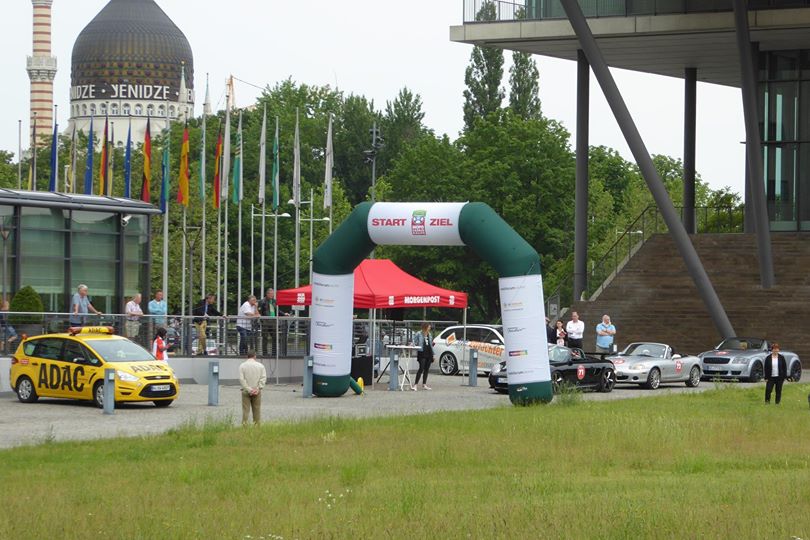
On our way back to the BnB, we came across the start of a cabrio car rally that had some pretty expensive machinery involved. No-one spoke English so I couldn’t get any information on what it was all about.



We also came across an Antique and Treasure market that had all of the usual bric-a-brac, except this in had war paraphernalia from the other side. There were quite a few things that tempted us, and there was one stand that sold not only 78RPM records, but players as well. With a mighty effort we resited the temptation, only buying the obligatory jar of home-made jam.

We packed and arrived at the station about 30 minutes early for the train to Berlin, but were told that the later we bought a ticket, the more it cost. The first time we experienced this. We could by tickets for the next train at 80 Euros, wait 2 hours for the next one and pay only 48 Euros, or travel in the evening for even less! We gave in and caught the early train.


What’s under a manhole cover? Well a catch tray filled mainly with lots of cigarette butts.


The 2 hour train trip to Berlin passed quickly as we shared a compartment with a Chines couple from Beijing. They have been working as journalists for Chinese media in Berlin for the past year, so we had some interesting discussions about cross-cultural situations. The most interesting thing he said was that even if he spoke German (and he did very well) to the locals they almost always responded in English (which he also spoke quite well) as it was the language of international communication. Regarding food – the 20 workers at the office have a Chinese chef to prepare meals.

We arrived in Berlin Hauptbarnhof which is a five level railway station that is also an exchange point for trams, buses and suburban trains. Finding our way, even to the tourist information centre, was not easy. We bought a 4-day transport ticket which also gives a 25% to 50% reduction on most attractions, so although a little expensive is worthwhile (travel hint). We had to catch a train then a subway to our BnB which involved a fair bit of suitcase lugging up and down stairs – we’d been spoiled by the excellent systems in Seoul and Prague.

Our accommodation is a small first-floor self-contained apartment in south-east Berlin in Friedrichshain-Kreuzberg which is a pretty multicultural area. We felt right at home, next to a French restaurant and a Turkish café. It's the same place Phil & Lyn stayed when they were here. We were both a bit tired and took the afternoon off.


It looked like there were some restaurants and cafes across the canal, so in the evening (it’s still light at 10pm) we headed out. Talk about restaurants and cafes, they were virtually wall-to-wall, and almost none were traditional German restaurants – Turkish, Italian, Vietnamese, Indonesian, Japanese, Korean, Mexican, and more.

The choices were so great, it was difficult to make a decision, but we looked into a Mediterranean restaurant.In Australia it usually means Lebanese but this was run by Turks. It had a really simple and smart décor and the food looked quite good, if a little tired – as in sitting in warming trays too long.

They had a simple system of choosing form their selection, and then charging accordingly which worked fine for us. Also they had a lemon beer that seemed quite interesting. It was 40% beer and 60% ‘lemonade’, so about 2% alcohol and tasted fine.

Frances had a soup (tasty but too oily) and Moussaka accompanied by chickpea and rice which she really enjoyed. I had a selection of lamb wrapped in eggplant topped with tomato, a stuffed capsicum, and cabbage rolls accompanied by rice and roasted, sliced almonds – again delicious but a little oily. Overall though, it was exactly what we wanted and an enjoyable evening out.


Day 18 - Berlin

Sunday 12 June The tourist brochure has very good day trip suggestions with maps, so we picked the Divided Berlin trip and followed the map. Our first point was Checkpoint Charlie, probably the most famous border crossing between East and West Berlin.

Before we got there we went to the nearby Checkpoint Charlie Museum, set across three levels in a building that was used by the media to monitor and report on news events there. The exhibition is incredibly comprehensive, documenting the events leading to the wall’s construction in 1961 to its destruction in 1989. I can remember hearing news about building the wall when I was at school, and thinking, if communism is so good, why to people have to be kept from leaving - simplistic but still a valid question.

The museum showed the many ingenious attempts to cross from east to west and the stories attached to them. There were some of the actual vehicles used to smuggle people out of East Germany. It successfully humanised the events, for example one telling panel contained the quote ”Sincere thanks to all GDR border guards who never wanted and never will show any accuracy in shooting at refugees”.

Far more refugees could have been shot, and some GDR border guards were taken off duty or punished for ineffectual execution of their responsibilities. There was the violoncellist, Mstislaw Rostropowitsch, an escapee, who returned from Russia 40 hours after the came down and played pieces by Bach. Almost three hours later, we exited the exhibition with a much better understanding of Berlin’s history, and stood with many other travellers to be photographed under the iconic border sign. The photos show a sample of the displays, written in four languages.


It was only a short distance from Checkpoint Charlie to a large section of the former wall, and site of government during the Second World War. The site is essentially bare, but there is a new exhibition Berlin 1933-1945 Between Propaganda and Terror. It is sited in the foundation and is open air, but under shelter – like a 200m bus shelter.

This was another excellent exhibition, documenting the rise of Hitler and the Nazis to their downfall and aftermath, leading to the separation of Germany. We spent another two hours there learning about the power struggles and machinations that allowed Hitler to take control, and of the failed resistance within Germany to stop him. His tactics in power were little different to those of Stalin and other autocrats in the eastern bloc.

It also provided background to the development of the Aryan ideals and persecution of any individual or group who did not fit this idealistic model. Hitler’s rise was also facilitated by the economic conditions of the time and his promises of jobs and growth. Australians take heed. This is a difficult topic for the Germans to deal with, but the exhibition was well done considering the process involved in selecting the issues and topics to be presented and the very emotional issues being covered.


By now we were pretty saturated with information, and needed a break. Frances was keen to see The Wall, a panorama exhibition of East Germany during the partition. I went to see the nearby Trabant Museum. As I said ealier during this long production run, millions of Trabants were produced and it was the most common vehicle in former East Germany. Iconic photos and film footage of the fall of the Berlin wall show East Germans driving across the border in their Trabants.

The museum had a selection of different models but was not really comprehensive. Also interesting was the fact that you could pay to drive a Trabi around the block, the little 600cc two-cylinder two-stroke engine chugging away.

There was also quite a bit of very colourful paraphernalia for sale by the artist Thierry Noir, a French artist who is claimed to be the first street artist to paint on the Berlin Wall.


Frances' first sausage in roll with a Berliner beer.

There are some pretty weird things here, for example curried sausages.

The smell of cheap curry is so bad you don't really want to stand downwind.

Day 19 - Berlin

Today we planned to explore a bit more of Berlin, the first stop being the Berlin Wall Memorial on Bernaur Str. This is an area where you can get a better feeling of the effects of the city being divided. There is an interpretive exhibition over a large area which reflects the scale and the futility of the division. It also included an open-air model of the area in steel and steel poles standing where the wall used to be. The exhibition explained how the East German government changed the wall over time in response the continuing desire of people in the east and west sides to communicate and the East Berliners to escape, either for a better life or join family and loved ones. In some cases East German government destroyed buildings and churches they found objectionable, for example a church whose spire was still visible on the western side. Diagrams also showed the contrast between the multitude of barriers and the eastern side versus none on the western side.


Next we went to the Brandenburg Gate. It is built on the site of a former city gate that marked the start of the road from Berlin to the town of Brandenburg an der Havel.

It was commissioned by King Frederick William II of Prussia as a sign of peace and completed in 1791. Having suffered considerable damage in World War II, it was restored from 2000 to 2002. During the post-war Partition of Germany, the gate was isolated and inaccessible immediately next to the Berlin Wall.

The area around the gate was featured most prominently in the media coverage of the tearing down of the wall in 1989, and the subsequent German reunification in 1990. (Wikipedia). It looked a bit of an anachronism, like broken teeth, surrounded by the bacteria of tourism. It was quite overcast with intermittent rain, so the photos are a bit dull.


From the Brandenburg Gate, it was only a short distance to the Reichstag Building, current seat of parliament and cultural symbol for Germans. It has a new central dome that the public can assess and view the city – only by prior booking. It was quite good with a fairly patronising audio accompaniment and a photo gallery of its history from the 19th century. If course it’s a bit sanitised, and refers to the Third Reich of Hitler as an illegitimate government.

Overall the Hitler years are treated almost as if they were different Germans to those of today. Of course they were, but not entirely foreign. With so much to see in Berlin, it’s easy to get into ticking off a tourist checklist of attractions. It’s more challenging to try to get a feel of the actual history and culture of the place.

Central Berlin is quite multicultural, and there is no homogeneous look to the people – a total failure of the Aryan ideal, especially since so many Germans (and others) were killed off during the two world wars. As we left and headed towards the Tiergarten we went through the Russian war memorial to the 2,000 soldiers who fell in the taking of Berlin.

All I could think of was the waste of life in the race by the allies to be the first into Berlin. We then walked through the adjacent Tiergarten which is a huge heavily tree-lined park – Similar in style to Hyde Park but on the scale of Centennial Park. The thing is that by the end of WWII, and the following year, every tree was destroyed or cut down for firewood. In other words, it has been totally restored and reforested since then. This had even more impact on us after seeing the immediate post-war photos.


It was my choice of dinner tonight, and I picked the Vietnamese restaurant with the really cool interior a couple of doors up the street. Because it was another European Cup night, every bar, café and restaurant had their big screen on, and this one was no exception. Also, most restaurants were empty tonight.

Fortunately the menu had German and English, and the waiter spoke English as well which made the ordering process quite easy. We ordered a Pretty Ginger Roast Duck and Little Miss Green Beef in Betel Leaves. The food was excellent, very fresh flavours and very well done – no photos unfortunately.

What was really good though, was the sense of humour in the menu. It’s a while since we had a laugh over a menu.

Entrees were:

  • Season Green, 
  • Glass Noodle Dream, 
  • Sunrise Papaya, 
  • Glass Noodle Pool, 
  • Wan Tan Wonderland, 
  • Mr & Mrs Springroll, 
  • Baby Springrolls, 
  • Mr & Mrs Summerroll. 


Mains were:

  • Pho Ocean, 
  • Red Sea, 
  • Little Miss Green, 
  • Ricenoodle on Fire, 
  • Golden Egg, 
  • Curry Fiesta, 
  • Bollywood Curry, 
  • Mango in Town, 
  • Tomato Fight, 
  • Sweet Sour Revenge, 
  • Soya Kid, 
  • Hot Basil, 
  • Lost in Lemon, 
  • Pretty Ginger, 
  • Pineapple Beauty, 
  • Legend of Celery. 


Finally, deserts were:

  • Banana Pyjama and 
  • Pina Pyjama.